Start with the feeling, not a colour rule
A three-colour palette is a small set of colours you choose to repeat within one outfit. It is not a rule that every visible item must fit perfectly into three boxes. Think of it as a way to give your eye a few points of connection: perhaps a blue shirt relates to a blue detail in a scarf, while a brown belt picks up the tone of your shoes.
Before opening your wardrobe, choose a few words for the impression you want to create. “Quiet and warm,” “bright and playful,” or “crisp and graphic” will each suggest different combinations. These words are more useful than asking whether colours are objectively right together. The goal is to build an outfit that expresses something you recognise as yours.
Choose an anchor, a supporter and an accent
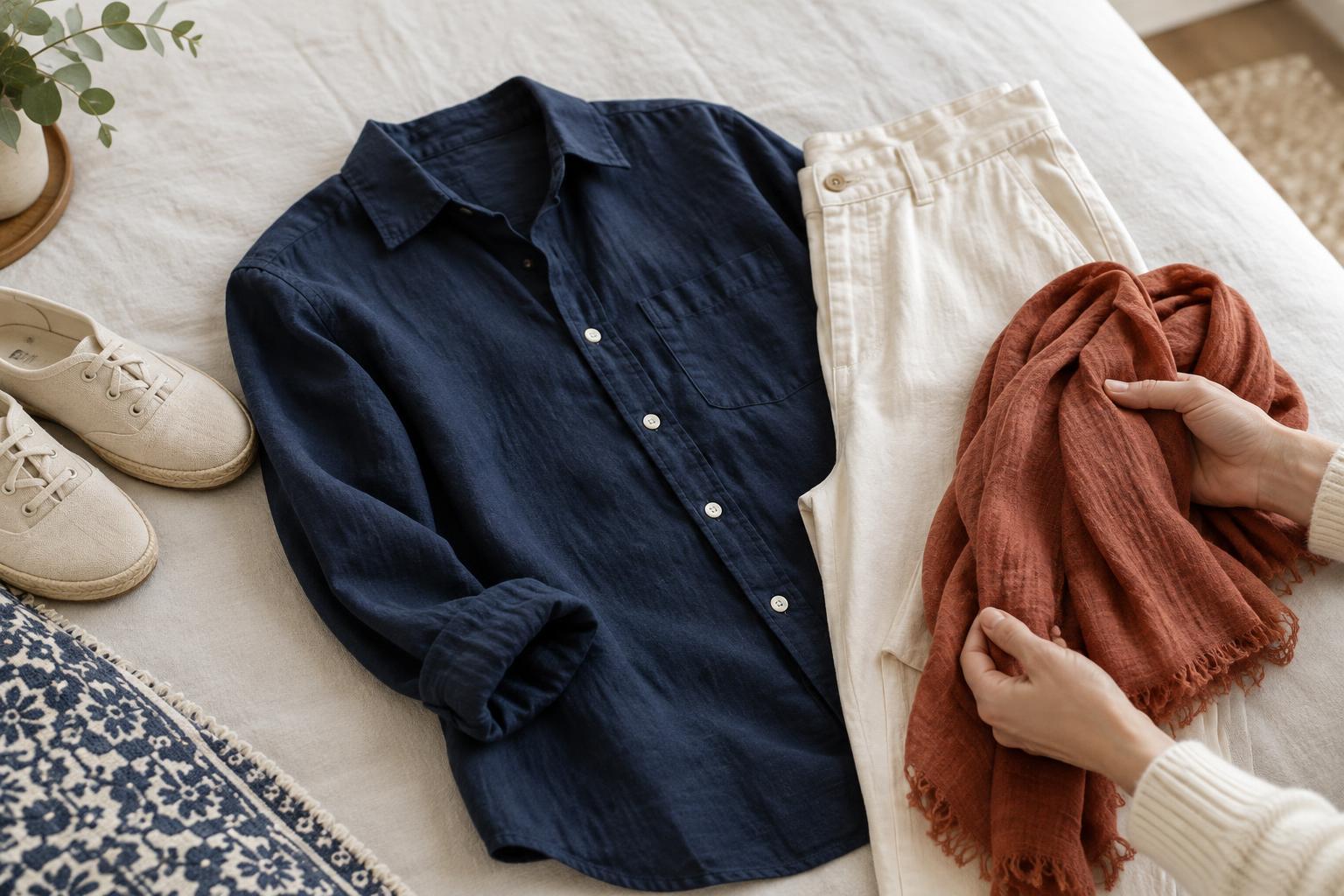
For this exercise, give each colour a job. The anchor takes up the most visual space, often in trousers, a dress, a jacket or a matching set. The supporting colour appears in another noticeable garment. The accent is a smaller point of interest, such as a bag, socks, earrings, a necktie or a stripe in a print. These roles help you begin; you can change the proportions once you see the outfit on.
Start with a piece you want to wear and let its colour become your anchor. If that piece is olive trousers, you might add a cream shirt as the supporter and a rust-coloured scarf as the accent. If you begin with a cobalt sweater, charcoal could provide a calmer base while a small flash of orange adds energy. Neither combination is a formula you have to copy. What matters is how the colours work on your actual clothes, in their actual sizes and textures.
Try the ten-minute wardrobe exercise
Lay your anchor piece where you can see it clearly. Pull out two possible supporting pieces and two possible accents. Arrange one supporter and one accent beside the anchor, then swap them to make at least three combinations. You do not need to put everything on immediately. Looking at the pieces together makes it easier to notice whether one colour overwhelms the others or whether the combination feels too subdued for what you had in mind.
Next, try on the most promising combination and look at the whole outfit from a few steps away. Ask yourself where your eye goes first. If the accent draws more attention than you want, use less of it or move it farther from your face. If the outfit feels disconnected, repeat one colour in a small second place: a bag that echoes your shoes, for example, or a hair accessory that picks up a colour in your top. Take a photo if it helps you compare options without relying on memory.
Let prints and textures join the palette
A patterned item can do much of the selection work for you. Choose one colour from a print as the anchor, another as the supporter and a third as the accent. A printed shirt with navy, pale pink and green, for instance, gives you several starting points. You can let navy trousers carry the largest area, keep the shirt as the connecting piece and add a small green accessory. You do not need an exact colour match; a related shade may look more natural.
Texture also changes how a colour feels. A glossy black bag, soft black knit and faded black denim may all read differently, even though they share a colour name. When a palette seems flat, try changing a material before adding a fourth colour. Conversely, if a vivid print and a shiny accessory compete for attention, a matte or softly textured piece may give the eye somewhere to rest.
Keep what works and adjust what does not
After wearing your outfit, make a brief note of what you liked. Was the accent easy to wear, or did you keep noticing it? Did the supporting colour make the anchor feel more like you? Save a photo or write down the three colours alongside a few words about the mood. Over time, you may notice combinations you return to, as well as colours you enjoy more in small details than in large garments.
You can repeat the exercise with the same anchor and a new accent, or keep the accent and change everything around it. That is the useful part of a three-colour palette: it gives you enough structure to make a decision while leaving room to experiment. The finished outfit does not have to demonstrate a perfect colour theory lesson. It only has to communicate the feeling you chose at the start.


