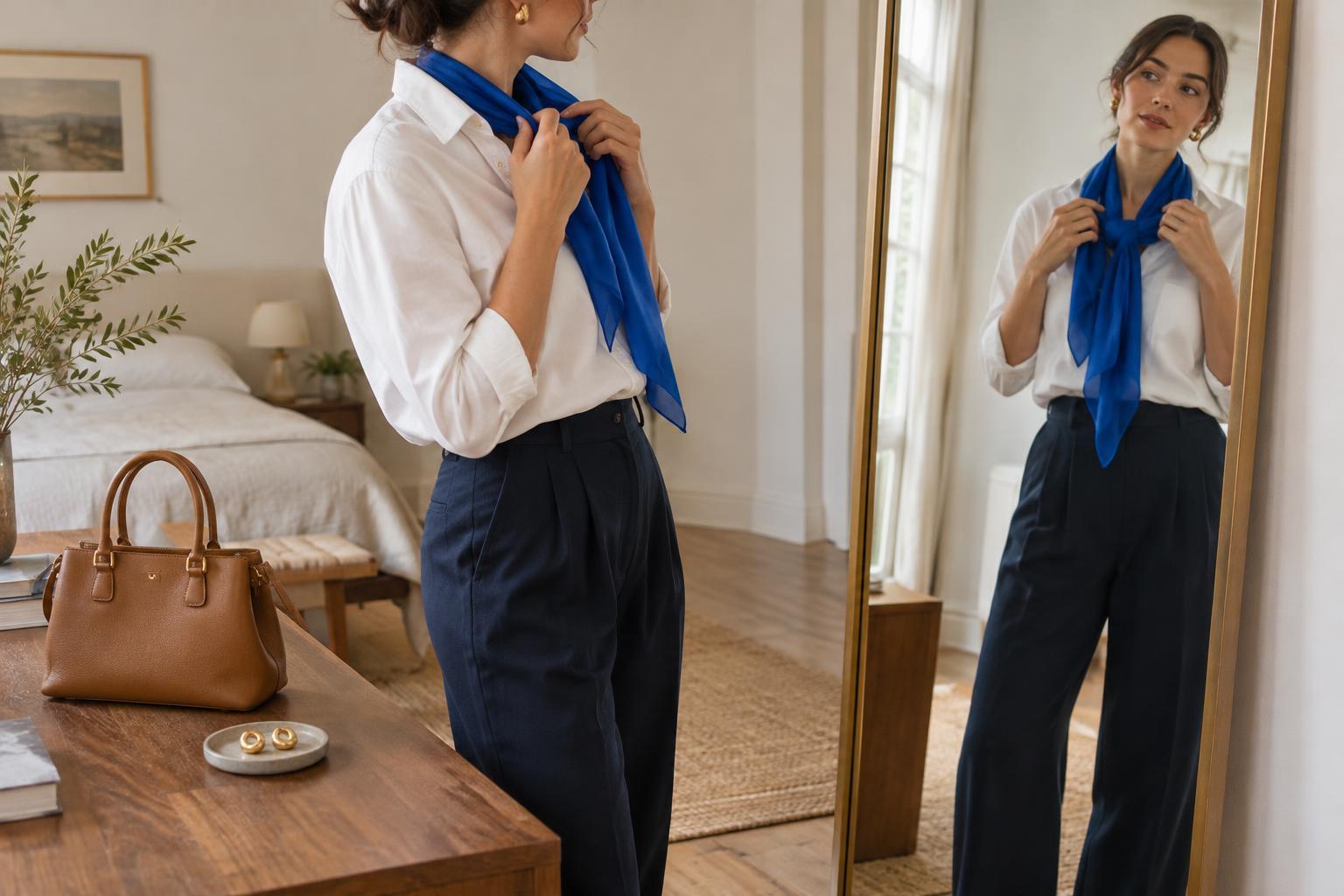
Start with an outfit you already wear
Choose an outfit that feels familiar: perhaps a shirt and trousers, a simple dress, or jeans and a knit. The point is not to build a perfect look. It is to create a steady background so you can see what one accessory changes. Put on the shoes and any everyday pieces you intend to keep, then leave them in place throughout the exercise.
Before adding anything, describe the outfit in three words. You might write “quiet, practical, relaxed” or “neat, soft, understated.” These are observations, not verdicts. Take a mirror photo if it helps you compare versions later, using the same position and lighting each time. A consistent view makes small differences easier to spot.
Choose a single place to experiment
Pick one accessory category and gather two or three options you already own. Try only bags, only belts, only scarves or only earrings. Comparing items that occupy the same place in an outfit makes the swap clearer. If you change earrings, shoes and a jacket together, you may like the result, but you will not know which detail shifted the mood.
Look for options with distinct characteristics rather than three near-duplicates. For example, you could compare small silver hoops, bright beaded earrings and long sculptural earrings. With bags, you might choose a soft canvas tote, a compact structured bag and a colourful crossbody. You do not need a large collection; two contrasting pieces are enough to begin.
Set the first accessory aside and photograph or describe the outfit without it. Then add one option, observe it, remove it and try the next. Resist the urge to adjust other parts of the outfit between swaps. Keeping the base unchanged turns an ordinary styling session into a useful comparison.
Notice what creates the change
Ask what your eye notices first. A bright scarf may bring attention toward your face, while a wide belt may draw attention to the centre of the outfit. A large bag can become a prominent shape; a small bag may leave the clothing as the main event. None of these effects is automatically better. The question is whether the point of attention supports what you want to express.
Next, consider the accessory’s visual qualities. Strong colour contrast can make a detail feel more pronounced. A tone close to your clothing may feel more integrated. Smooth metal, worn leather, crisp fabric and soft knit each add a different surface quality, even when their colours are similar. Shape matters too: rounded forms can echo soft lines, while angular forms can introduce a sharper note.
Write three new words for each version of the outfit. Avoid stopping at “nice” or “not nice”; try descriptions such as “playful, visible, informal” or “focused, polished, reserved.” You may find that a piece you love on its own gives this particular outfit a mood you do not want. That is useful information, not a reason to stop wearing it.
Match the mood to your intention
Now give the outfit a purpose. Imagine wearing it to meet a friend, give a presentation, visit a gallery or spend an unplanned afternoon out. Which accessory version feels most like you in that setting? You are not trying to follow a dress code invented for the exercise. You are deciding what you want the outfit to communicate and how you want to feel wearing it.
Check practicality alongside appearance. Can you carry what you need in the bag? Will the earrings remain comfortable for the time you plan to wear them? Does the scarf stay where you want it? An accessory that looks expressive in a photo but distracts you all day may not be the strongest choice for that occasion.
If none of the options feels right, name what is missing. Perhaps you want the colour of one piece with the smaller scale of another, or the relaxed texture of a tote in a more compact shape. That observation gives you a clearer reference for future styling than a vague sense that the outfit needs “something.”
Keep a record you can use
Save the photos or jot down one sentence about each version: “The patterned scarf makes this feel lively, but I prefer the plain belt for a quieter day.” Over time, these notes can reveal the details you repeatedly reach for when you want to feel bold, calm, playful or composed. They can also show that the same accessory behaves differently with different clothes.
Repeat the exercise with another familiar outfit, changing only one accessory again. The goal is not to assign every item a permanent meaning. It is to build a more precise sense of how a small detail works in context. Once you can recognise that shift, choosing an accessory becomes less about adding a finishing touch and more about making an intentional expression.


