Start with the idea, not the angle
Before lifting your camera, decide what you want the photograph to communicate. Perhaps the outfit is about the shape of a wide coat, the contrast between a neat shirt and worn-in shoes, or the ease of getting dressed for an ordinary afternoon. A camera angle cannot create that idea on its own, but it can direct attention toward it.
Look at the outfit in a mirror and name one feature you want viewers to notice first. Then consider what they should notice second. If the story is about a patterned scarf, a full-body image from across the room may make it too small to read. If the story is about how several pieces work together, a close-up of the scarf will leave out the relationship between them. This simple choice gives your angle a purpose.
Use camera height to change emphasis
A camera held around chest height often gives a relatively straightforward view of an outfit. You can see the proportions of the top and bottom without making either end of the body the obvious focal point. It is a useful starting point when you want the clothing to speak before the camera technique does. Keep the phone or camera roughly level and take a test image before making adjustments.
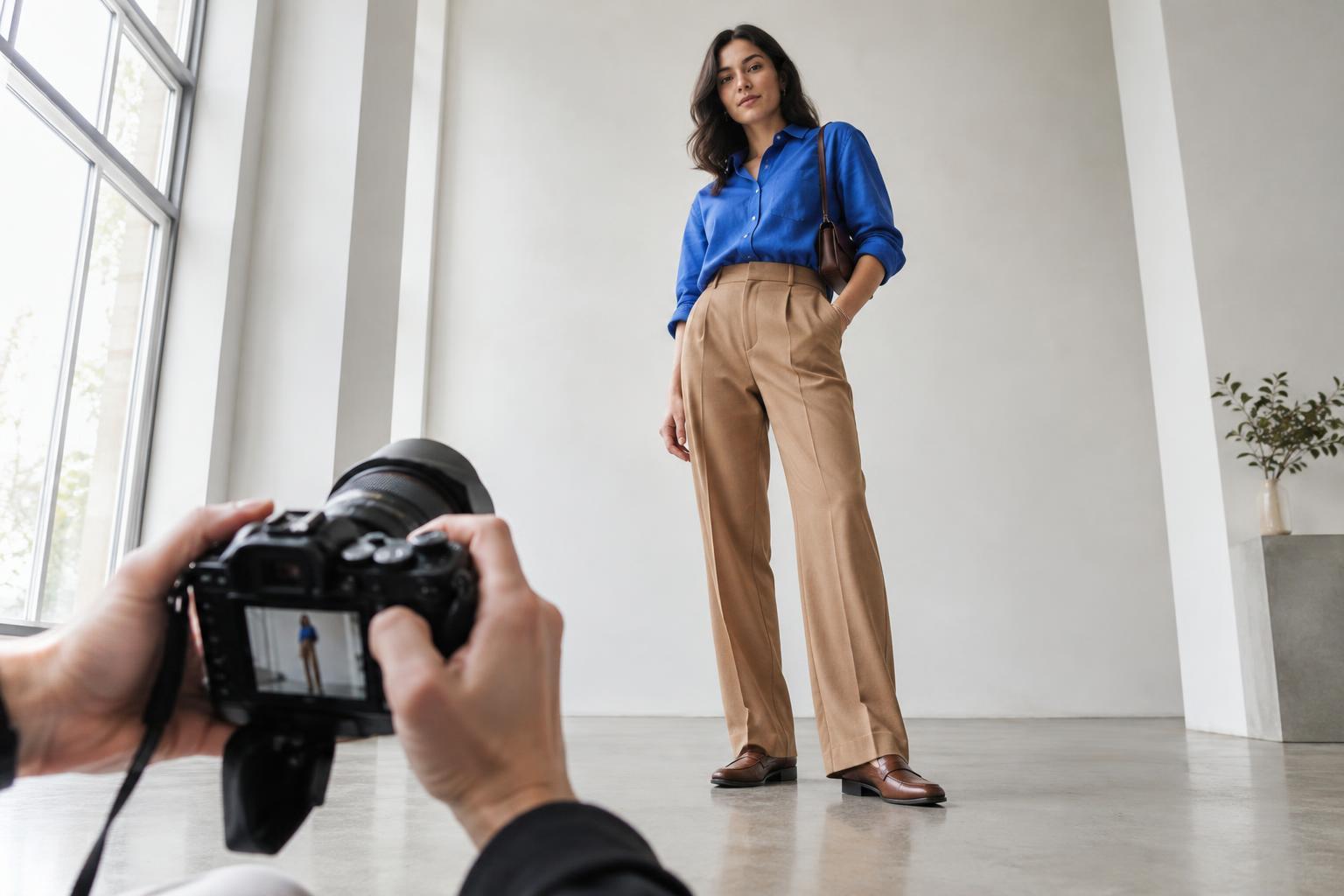
A lower angle can draw attention to shoes, trouser shape or the sweep of a long layer. It may also make objects nearer the lens appear larger, especially with a phone’s wide-angle camera. A higher angle tends to bring a collar, necklace or hairstyle forward while making lower details less prominent. Neither choice has a fixed meaning: the effect depends on your pose, surroundings and how close the camera is. Ask whether the emphasis supports the outfit story rather than whether the angle is universally flattering.
Let distance and framing set the pace
Camera distance affects how much context enters the frame. Step back to show the full silhouette, the space around it and the way an outfit belongs in a setting. A doorway, wall or stretch of pavement can provide useful visual structure without becoming the subject. Move closer when texture, layering or a small styling decision carries the idea. A cuff folded over a sleeve may say more about your approach to dressing than a distant head-to-toe shot.
Framing also changes the rhythm of an image. Centering the outfit can make its overall shape easy to read. Leaving space on one side may suggest movement or draw the eye toward a bag or flowing hem. If you crop at the knees or waist, check what happens to the garment’s lines: an accidental crop can hide the very proportion you meant to show. Make these choices while taking the photo when possible, so you can see the result rather than guess.
Check what perspective is doing to the clothes
When a camera is close to an outfit, the nearest elements can appear more prominent than those farther away. An outstretched sleeve may dominate a frame; shoes photographed from near floor level may seem unusually large. That can be expressive if scale is part of your idea, but it can also obscure the fit or shape you hoped to capture.
For a clearer record of the whole outfit, place the camera farther away and crop the image afterward if you have enough detail to do so. Keep vertical features such as doorframes reasonably straight if you want a calm, balanced impression. If you prefer a more energetic image, try tilting the camera deliberately, then compare it with a level version. The useful question is not whether the image is technically perfect, but whether its perspective helps people see what you intended.
Make a small angle study
Choose one outfit and one spot with steady light. Without changing the clothes, take three full-body photographs: one with the camera around chest height, one slightly lower and one slightly higher. Keep your distance and pose as similar as you can. Next, make two more images: a wider view that includes the setting and a closer view of the detail you named at the start.
Review the five images side by side. Notice where your eye goes first, what disappears and whether the outfit feels composed, relaxed, dramatic or intimate to you. Write down which image best matches your original idea and why. You do not have to find a single angle that works for every outfit. The aim is to build a small visual vocabulary you can use whenever you want a photograph to express more than simply what you wore.


