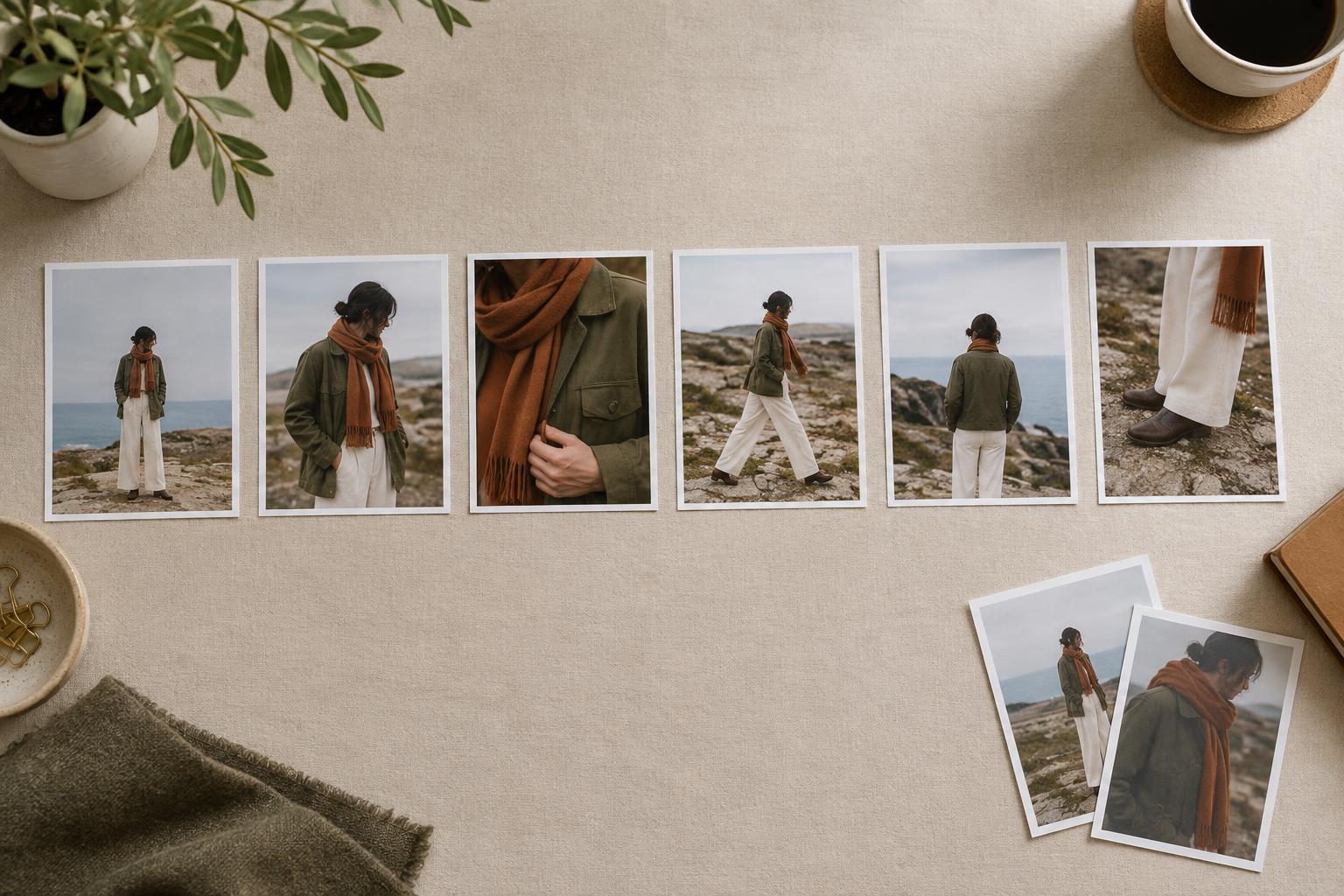
Choose the point of the sequence
Before selecting photos, finish this sentence: “I want the viewer to notice…” Your answer might be the contrast between a tailored jacket and soft fabric, the way one bright accessory connects an outfit, or how a look changes when its layers move. This gives you a reason to include each image beyond simply liking it.
A photo sequence does not need a plot, but it benefits from a beginning, a development and an ending. The beginning introduces the outfit or its setting. The middle draws attention to the choices that give it character. The ending leaves a clear final impression, perhaps through a full look, a gesture or a small detail seen in a new way. Keep this structure loose enough to suit the photos you have.
Make a first edit for variety, not completeness
Lay out the available photos where you can see them together. On a first pass, set aside images that are difficult to read: an accessory hidden by a hand, a pose that obscures the silhouette, or a background that pulls attention away from the outfit. Then group similar images, such as full-length views, close-ups and movement shots.
Choose one strong candidate from each useful group rather than keeping every version of the same pose. Two nearly identical images can make a sequence feel stalled, even when both are attractive on their own. Look for frames that answer different questions: What is the overall shape? Which details make the look personal? How does it feel when worn? If a frame adds no new information or mood, it may be better left out.
Do not confuse variety with constant change. A repeated colour, accessory or backdrop can help the set feel connected. The goal is to offer a fresh view in each frame while giving the viewer enough familiar elements to follow the thread.
Order images to control the pace
Start with an image that quickly establishes what the viewer is looking at. A full outfit view is often effective, but a distinctive close-up can work if the next frame reveals its place in the look. From there, alternate between broader and narrower views when that movement helps the eye travel. For example, a full look followed by a close-up of a patterned cuff and then a mid-length shot can show both the detail and how it works with the rest of the outfit.
Pace also comes from visual energy. A still, centered pose gives the viewer time to take in shape and colour; a walking shot or shifting layer can add momentum. Placing several busy images together may make individual details harder to absorb. A quieter frame between them can create a useful pause. You do not need a strict formula: compare neighboring images and ask whether the second image changes what the viewer knows or feels.
Try two possible orders before settling on one. In the first, lead with the whole outfit and move toward its details. In the second, begin with a striking detail and reveal the whole look later. The better version is the one in which each new frame feels both understandable and worth seeing.
Check transitions, then cut again
View the sequence at the size and in the format where you plan to share it. Small images can make subtle details disappear, while a close crop that looked exciting on its own may feel abrupt beside a wider shot. Check that important outfit elements remain visible and that changes in lighting, background or framing do not accidentally suggest a different look.
Pay particular attention to pairs of images. If two frames have similar poses, try keeping the clearer one. If the jump between frames feels confusing, look for an image that bridges their scale or viewpoint. Avoid adding a bridge simply to smooth the edit, though: sometimes a direct jump from a full look to a tiny detail is exactly what makes that detail memorable.
Finally, remove one image and view the set again. If nothing important is lost, leave it out. A concise sequence gives each remaining frame more room to do its job.
Use a quick exercise to find your rhythm
For a focused practice session, choose photos of one outfit and make a five-image sequence. Give each image a role: introduction, first discovery, change of scale, moment of movement or pause, and closing impression. These are prompts, not rules; a single frame may serve more than one purpose.
Show the sequence to someone without explaining your intention. Ask what they noticed first, which image they lingered on and whether any frame felt repetitive or out of place. Their answers can reveal a gap between the story you meant to tell and the one the images communicate. Adjust the order or selection, then look through it once more at a natural viewing speed. Stop when the outfit’s character comes through without needing a caption to explain every choice.


