Start with what the detail says
Before picking up a camera, finish this sentence: “I want this outfit to feel…” Your answer might be precise, relaxed, playful or quietly sentimental. Then look for a clothing detail that carries that feeling. A sharply folded collar can suggest care; a loose scarf knot might suggest ease. A detail does not need to be unusual to matter. It needs to help a viewer understand the person or idea behind the outfit.
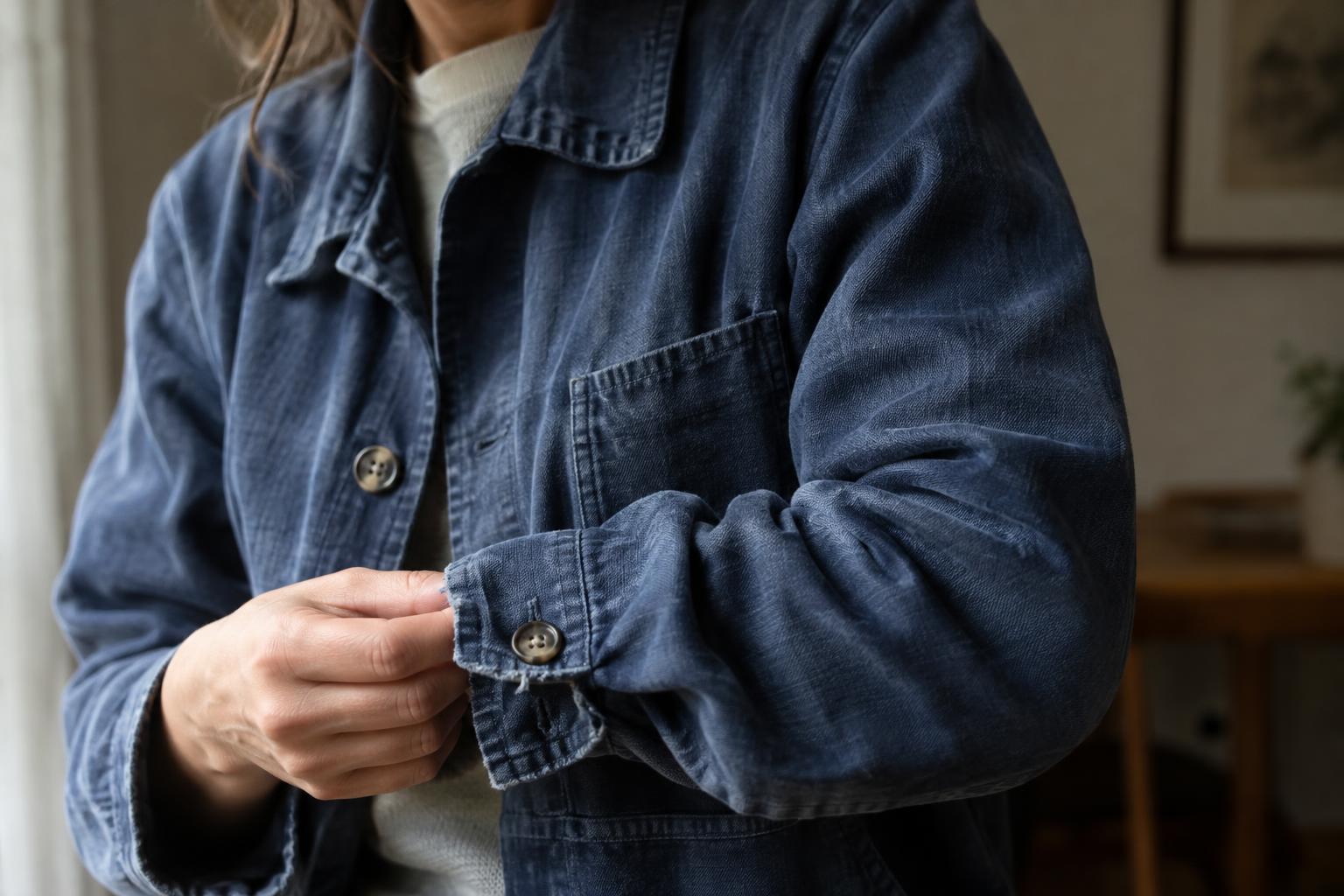
Choose one primary detail for each photograph. If you are drawn to the stitching on a sleeve, decide whether the stitching itself, the shape of the sleeve or the hand adjusting it is the subject. This small decision gives you a clearer place to focus. Try making a short list of three details before shooting: one that describes the garment, one that shows how it is worn and one that reveals something personal, such as a repaired seam or a frequently used pocket.
Use light to reveal texture and shape
Soft daylight from a window is a useful starting point because it lets you see folds, stitching and surface texture without requiring elaborate equipment. Turn the garment or your body gradually and watch how the light changes the detail. Light coming slightly from the side often makes raised embroidery or a woven surface easier to see. If a shiny button produces a distracting reflection, change your angle before changing anything else.
Check what happens in the darkest and brightest parts of the frame. Black fabric can lose its folds in deep shadow, while pale fabric can lose its weave when it is too bright. On a phone, tap the detail you want to emphasize and adjust the brightness if your camera allows it. Take a few versions rather than trusting the first image. Moving a step nearer to the window or turning a shoulder can make a meaningful detail visible without changing the mood of the scene.
Frame the detail without losing its context
A close-up can show craftsmanship, but an extremely tight crop may leave a viewer unsure what they are seeing. Photograph the same detail at two distances. First, fill much of the frame with it. Then step back enough to show where it belongs: the cuff beside a hand, the belt against the coat or the hem above a pair of shoes. The wider image gives the close-up a place in the outfit’s story.
Look around the edges of the frame before taking the picture. A stray bag, a bright object in the background or a cut-off hand can compete with your chosen detail. Simplifying does not mean removing all personality from the setting. A doorway might reinforce a crisp silhouette; a worktable might give context to a practical apron. Keep what adds meaning and move, crop or change your position to exclude what does not.
Show how the clothing lives on a person
Clothing changes when it is worn. A sleeve bunches at the wrist, a pleat opens during a step and a necklace shifts with a turn of the head. If the story is about comfort, habit or movement, photograph the detail in use rather than arranging it perfectly. Ask the wearer to repeat a natural action slowly, such as fastening a coat or reaching into a pocket, and take several photographs as it happens.
Hands and posture can provide context without turning every image into a portrait. A hand resting on a patched knee suggests a different relationship to the garment than a hand smoothing a new crease. Be deliberate about what you include: the person is not merely a prop for the clothing. If photographing someone else, agree on which images they are comfortable making and sharing. That conversation can also help you understand which details hold meaning for them.
Edit the photographs into a small story
After shooting, choose three to five images rather than keeping every successful close-up. Start with a frame that establishes the outfit or setting, follow with a detail that rewards a closer look, and finish with an image that adds a human gesture or a contrasting view. The order should offer something new at each step. Several nearly identical photographs of a button may be attractive, but they rarely tell the viewer more than one can.
For a simple exercise, photograph one garment in five frames: its overall shape, a construction detail, its most distinctive colour or pattern, a detail in motion and a sign of how you wear or care for it. Lay the images side by side and ask what someone could understand without a caption. If the sequence misses the quality you meant to express, reshoot one frame with that quality in mind. The aim is not to document everything; it is to make your choices visible.