Start with the shape, not the knot
Before tying a scarf, hold it by two corners and notice how it falls. A small square folds into a compact band that works well at the neck, wrist or bag handle. A larger square makes a visible triangle and offers more fabric to drape over the shoulders. A long rectangle is suited to loops and loose ends, while a narrow scarf creates a slim line with little bulk.
Fabric changes the result, too. A crisp cotton scarf may hold a pointed fold; a soft, fluid one will tend to drape. If you want a neat tie, smooth the fabric as you fold and leave yourself enough length to make the knot without pulling it tight. For a softer effect, let a few folds remain visible. There is no single correct finish: the useful question is whether the scarf creates the shape you intended.
Tie a square scarf three ways
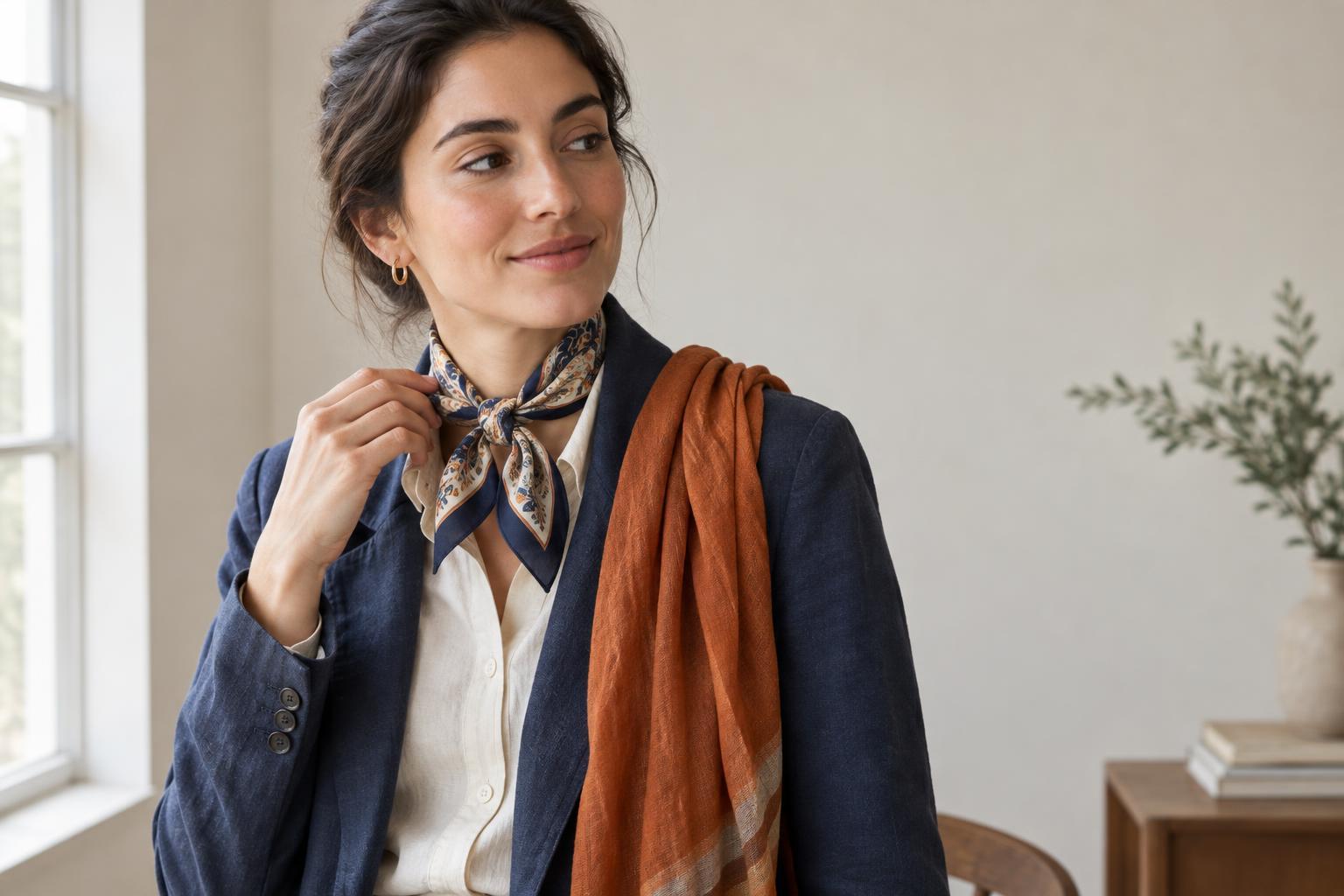
For a small neck knot, lay the square flat and fold it diagonally into a triangle. Starting at the long edge, fold toward the point until you have a band. Place the middle of the band at the front of your neck, bring the ends behind, cross them and return them to the front. Tie one loose knot slightly off-centre. Shift the knot to the side for a playful detail, or keep it near the middle for a more balanced look.
For a triangle drape, fold a medium or large square diagonally and rest the long edge across the back of your neck. Let the point hang at the front, then bring the two ends forward over your shoulders. Leave them free for an open shape, or knot them loosely beneath the point to keep the scarf in place. Adjust the front point so it sits where you want attention to fall.
For a bag accent, fold a small square into a band and tie it once around the base of a handle. Pull the two ends until they are similar lengths, or leave one longer for an uneven, relaxed finish. Keep the knot clear of any fastening you need to use.
Give a rectangular scarf a different line
The simplest long-scarf tie is a single loop. Set the scarf around the back of your neck with one end longer than the other. Take the longer end around your neck once, then let both ends fall at the front. Loosen the loop with your fingers so it does not press against your throat. Even ends give a tidy, vertical line; uneven ends look more casual.
For a folded loop, bring the two ends of a long scarf together so it is doubled. Place the folded scarf behind your neck, then pull both loose ends through the loop at the other side. Ease the loop outward until it sits comfortably. This creates a compact shape that can work well when you want warmth or a clear scarf detail without managing two loose ends.
If the scarf is narrow, try a low knot instead. Drape it around your neck and tie the ends once near the upper chest, leaving the tails to hang. A low knot draws the eye downward; moving it closer to the collar makes the detail more prominent. This tie also works over a simple shirt when a larger loop would cover too much of the neckline.
Change the effect with placement and volume
The same scarf can read differently depending on where it sits. A close neck tie frames the face and draws attention to the collar area. A loose drape shows more of the garment underneath and adds movement. A knot at one side creates an uneven shape; a centred knot feels more orderly. Try each placement in a mirror before changing the scarf itself.
Think about how much of the print you want to reveal. Folding a patterned square into a narrow band may show only flashes of colour, while a triangle displays a larger portion of its design. Against a busy outfit, a compact tie can provide a small point of focus. Against a plain top or coat, a wider drape gives the scarf room to become the main detail. These are options, not rules: choose the balance that feels like yours.
Make the tie comfortable and repeatable
Once you find a shape you like, notice the small decisions that produced it: which side faced outward, where the fold began and how much length you left in the ends. You can take a quick photo for your own reference. On another day, repeat the tie with a different scarf and see how the fabric changes it.
Before heading out, turn your head, lift your arms and check that the scarf stays comfortable. Loosen a tight knot, tuck a slipping end or move a long tail away from anything it could catch on. The most useful scarf tie is one that expresses what you want without needing constant adjustment. Start with one fold and one knot, then let colour, texture and placement do the rest.