Your clothes do not owe anyone an explanation
A piece of clothing can mean one thing to you and suggest something else to a stranger. A colour might remind you of home, while someone else simply sees a bright coat. That gap does not make your expression unsuccessful. Dress is a way to communicate, but it is not a complete account of who you are.
It can help to separate three questions: What do I want to feel when I wear this? What might other people notice? How much, if anything, do I want to explain? You can enjoy a meaningful detail without making its meaning public. A ring, a lining, or a particular combination of colours can serve as a private reminder even when nobody else recognises it.
Choose your level of visibility
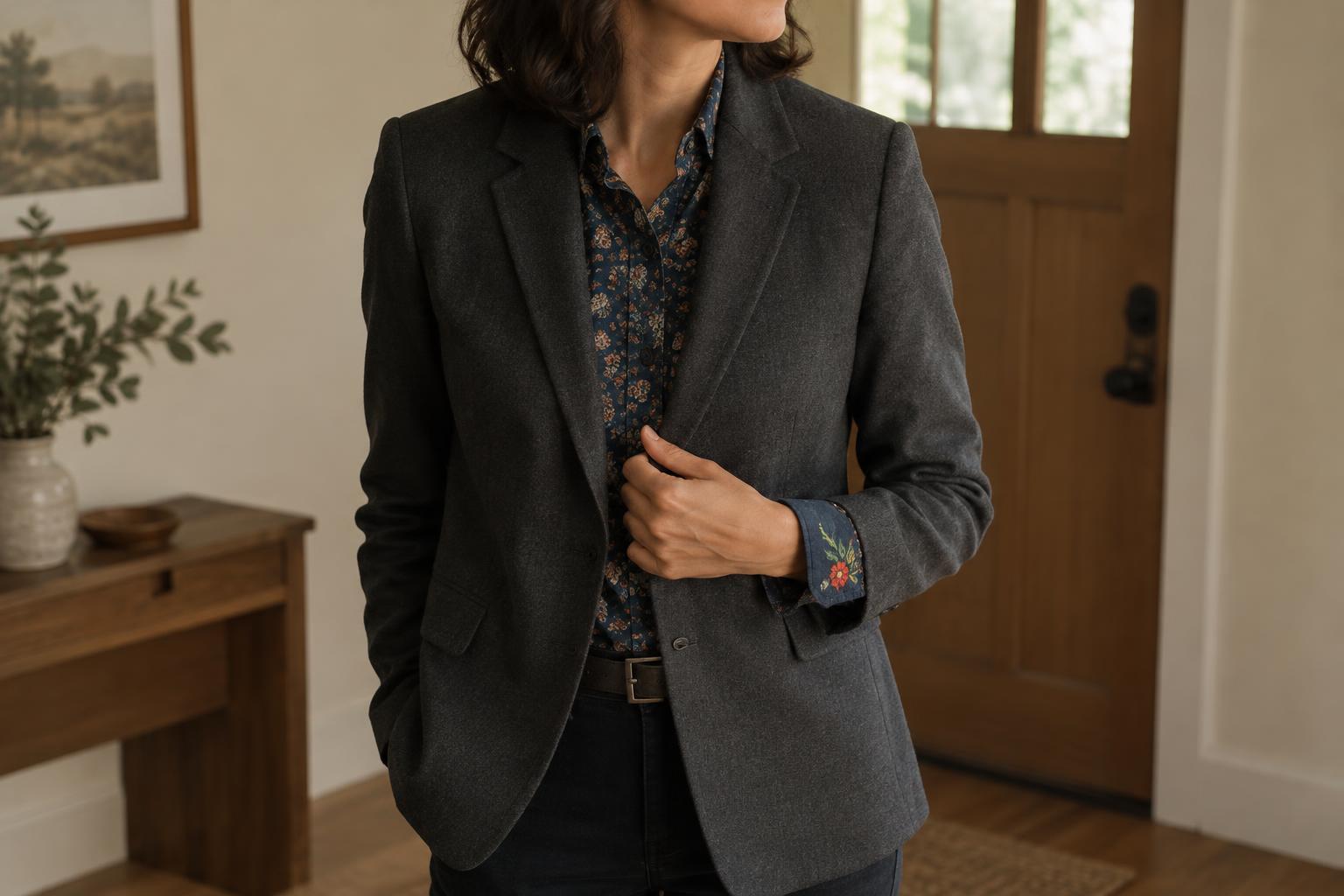
Think of expression as a range rather than a choice between hiding and revealing everything. At one end are details intended mainly for you: a familiar texture, a small charm tucked into a pocket, or a colour worn beneath a jacket. In the middle are visible choices whose meanings you can leave open, such as an unusual silhouette or a patterned scarf. At the other end are choices you make knowing they may invite questions, such as a prominent slogan or a striking accessory.
Try a simple wardrobe exercise. Pick three items you reach for because they feel personal. For each one, write two short notes: what it means to you and what you are comfortable saying about it. Your answer to the second question might be a full story, a brief description, or “I just like wearing it.” None is more authentic than the others. The point is to make the choice yours before someone asks.
Dress for the setting without abandoning yourself
Different spaces invite different kinds of presentation. You may want your clothes to support ease and connection at a gathering, focus at work, or freedom of movement on a busy day. Adjusting your outfit to a setting is not necessarily a compromise of identity. It can be a practical decision about which parts of yourself you want to emphasise there.
Start with the demands of the day: comfort, movement, weather, and any expectations you need to consider. Then choose one detail that feels distinctly yours. If a bold print feels distracting in a particular setting, you might carry the same colour in a belt or bag. If an accessory attracts more attention than you want, you might wear it when you have more energy for conversation. These are options, not rules; the aim is to find a balance you can live in comfortably.
Prepare for curiosity, not just compliments
Visible choices sometimes prompt questions. A question may be friendly, awkward, or more personal than you expected. You do not have to decide on the spot how much of your history to share. Having a few responses ready can make a favourite item easier to wear: “It has a personal meaning,” “I found the colours interesting,” or “I’d rather keep that story to myself.” Each response gives the other person a clear answer without giving away more than you intended.
You can also choose an outfit with your capacity for attention in mind. On a day when you welcome conversation, a distinctive piece might be enjoyable. On a day when you want quiet, a subtler version of the same idea may feel better. Neither choice says more about your confidence or creativity. It simply respects how you want to move through that day.
Let your boundaries change
What feels private now may become something you want to share later, and the reverse can also be true. An item that once felt easy to discuss might begin to feel too personal. Give yourself permission to change how you wear it, who sees it, or what you say about it. You are not required to maintain a consistent public story around every style choice.
To check in with yourself, take a photo of an outfit you enjoyed wearing and describe it in two sentences. Write one sentence about what others could see and one about what the outfit did for you. Notice where those sentences overlap and where they do not. The difference is room for privacy, not a problem to fix. A useful personal style can hold both: a presentation that helps you meet the world and meanings that remain entirely your own.


